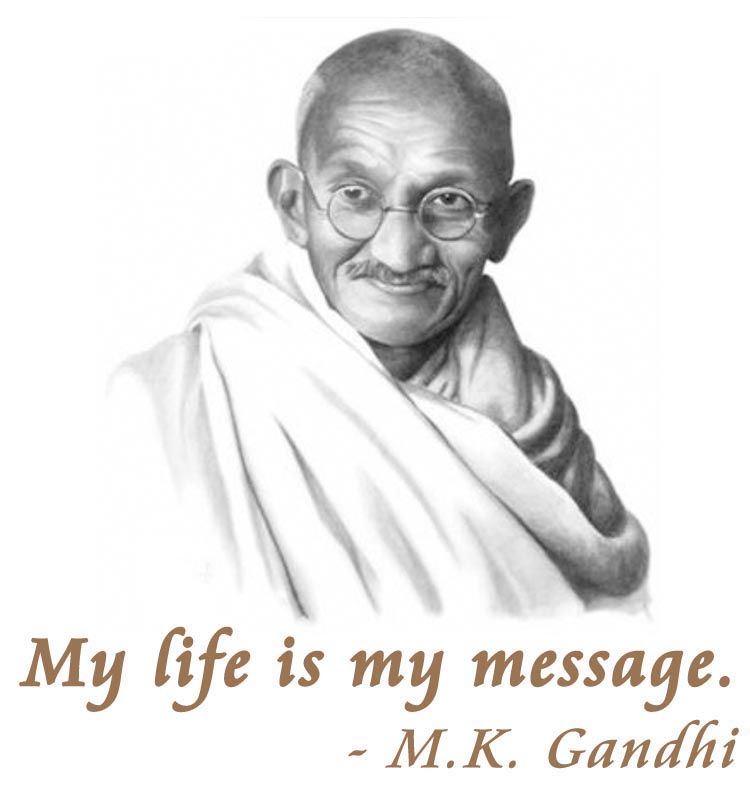
Mahatma Gandhi And Higher Education: A Critical Analysis |
By Dr. Ravindra Kumar Mahatma Gandhi in his article titled 'National Education' published in Young India on 1 September, 1921 has written that it might be true regarding other countries but in India where 80% of the population is occupied with agriculture and 10% of it with industries, it is an offence to make education merely literary1. It is apparent from these lines that according to Mahatma Gandhi, education is not only to gain literary knowledge. Although he has tried to confine his above mentioned statement within the Indian perspective, in my opinion education cannot be restricted to the knowledge of letters of alphabet or the study of literature irrespective of the circumstances or the economic resources of any nation in the world. In addition to literary knowledge, education should include the moral, physical and mental development of a person. In course of time, education has to develop a person in all respects in order to enable him to become self-reliant. To become self-dependant or for his all-round development, it is necessary that he should have moral upliftment in addition to his physical or intellectual development. It is absolutely necessary that he should not only be able to earn his bread, but should be able to fulfill the obligations of his family and in carving the path of his progress, should ultimately be able to achieve his goal in life. A young man or woman may pass the Graduate or the Post-graduate examination with first division or may further acquire the M. Phil. or Ph.D. degree, but still he/she does not become self-dependant and is not able to channelize his/her future along successful lines by worrying about his/her day-to-day problems. In such a case, will the education received by him/her or the degrees acquired by him/her be regarded as meaningful? In my opinion such an education or degree is useless. This reality can be perceived not only in India but in other countries also. Therefore, Mahatma Gandhi's statement that education does not mean getting literary knowledge is true even in the context of the world. Today, due to an increasing population, there is a lot of competition for getting admission in colleges and universities. This is more true in the case of higher education. Everyone wants to go in for graduation, post-graduation, M. Phil or a Ph.D. degree. That is not all, thousands of students stand in a queue for D.Litt. degree. What prospects are there after getting a degree or degrees? Many of them have no hope for a bright future. A person, who has spent a major, precious part of his life in obtaining a degree or passing through any level of higher education and who has not received any guidance for the future or is unable to make himself self-dependant, should he be considered educated? The answer would be in the negative. This is what is happening. It appears that education today has failed in giving any direction. It is a fact that our system of education has been defective for the last many decades. Even after independence, our leaders have not taken such steps as they should have to reform our defective educational system. Since independence and till now, many committees and commissions have been formed, but how much improvement has been made in the sphere of education? Not much. People like Dr. Radhakrishnan and Dr. Zakir Hussain, well-known educationists on national and international levels, have been the Presidents of our country. It is an anomaly that education has not been able to give right direction to our youths, or to provide them opportunities for their all-round development or to make them self-dependant. The number of students for higher education increases every year and is still growing further. If we do not awaken at the right time and bring changes in our defective educational system according to the view-points of Mahatma Gandhi, the situation would become so serious that we would not be able to manage it. Mahatma Gandhi, an advocate of a solid foundation for human beings was firm on giving free and compulsory elementary education2to all. In Harijan of 9 October, 1937, he wrote that he was firmly in favour of the principle of free and compulsory education for India. He further wrote that at this level along with the training in any trade, their physical, mental and spiritual potentialities also be developed. Under present circumstances, I would like to add further that arrangements should be made for free and compulsory education to all up to the secondary level3without any discrimination of lineage, gender, creed, caste or sub-caste. The government should do this. I firmly believe that if Mahatma Gandhi had been with us today, he would have held the same opinion. Imparting of physical and mental training for the growth of good physique and mind and moral education for the formation of character and good conduct on the elementary and the secondary levels should be the priority. Besides, students should have technical knowledge according to their interest at these levels so that it may enable them to become self-dependant in future. This type of education imparted at the secondary level will incorporate four kinds of education, viz. technical, physical-mental, moral and general [according to syllabus]. After having received this secondary education, students would certainly become self-dependant and would be able to choose the career they would like to follow. Each and every student should have a definite aim before he enters the field of higher education; otherwise it is meaningless to pursue higher education. There is a general thinking today that they would decide what they would do after having passed B.A. or M.A. or acquired some other degree. That is sheer waste of time and money and they would not achieve anything except groping in the dark. They will have a clear-direction only when the system of education at the secondary level is managed on the lines I have briefly discussed. Regarding this, it can be further said that a student should primarily pursue his studies at the graduate level on the basis of the elementary technical education he/she receives at the secondary level along with the other three. It is the requirement of the nation and is important at the international level as well. There is also the possibility of their becoming self-dependant. If Mahatma Gandhi's views on higher education are analyzed and reviewed in the perspective of the circumstances prevailing today, the above stated educational system would be according to them. It will be in proximity to his statement in which he expressed his desire that by changing the nature of college education, he would make it conform to the needs of the nation. Having become a graduate with technical knowledge any young boy or girl would be capable of seeking self-employment in a country with a population as large as in India and it will be comparably easy for him/her to get a government or non-government job. He or she can also pursue his or her studies further while doing his/her job. In this way, being self-dependant, a young boy/girl can continue his/her studies further to fulfill his/her aim and object. This is what Gandhi wanted. One who is self-employed will not have to run about after graduation for post-graduation or any other higher degree. Apart from this, he will not be required to waste precious time and money. It will naturally bring down the unnecessary crowding in colleges and universities. Besides, education will be purposeful and will be able to guide in the right direction. In short, these are Mahatma Gandhi's views on higher education and keeping them in mind, the system of education in India will have to be reformed. These views of Mahatma Gandhi can be our guide and can contribute to the management of our educational system. Mahatma Gandhi had talked about self-sufficiency of colleges and universities. It meant that these institutions instead of depending on government aid should be self-financed. India is an agricultural country. Most of the industries are based on agriculture. Gandhi wanted that more and more self-financed Agriculture-Colleges should be opened and they should be attached to related industries which would turn out graduates according to their requirement. Not only this, they should bear the expenses of their education and the training-staff. Gandhi wanted the same system to be adopted for graduates of engineering and medical colleges. Engineering graduates should be attached to the related industry and medical graduates to hospitals. Law, Commerce and Arts colleges can be managed by voluntary organizations and donations can be procured according to their requirement. Mahatma Gandhi was never in favour of government aid. He, however, wanted the universities' control over the colleges and that of the government over the universities. It is another matter that under the present circumstances, we have not been able to incorporate his views in our system of higher education, but they are worth giving a thought. The self-dependence he has talked about is certainly significant, otherwise how long will the colleges and the universities thrive on government aid? Keeping it in view, we will have to make a firm and well planned schedule and put it into practice. Reference:
*Dr. Ravindra Kumar is a Former Vice-Chancellor of CCS University, Meerut, India; Editor-In-Chief of Global Peace International Journal. Also he has been a consultant to UN University of Peace for Gandhian Studies. |