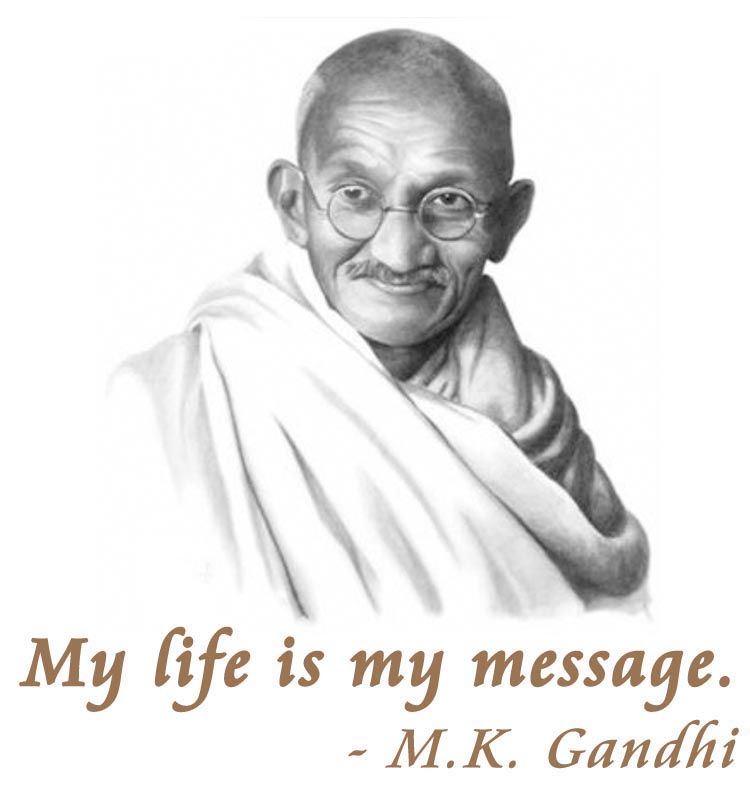
Mahatma Gandhi and his contemporary artists |
- Bhaswati Bandyopadhyay Art and artistic creation have always given a reflection of the social, economic and intellectual environment of a society. The period of the Indian freedom struggle was full of patriotism when everybody worked together under the leadership of great men. It is a well known fact that the Indian National Movement had a tremendous impact on public life. The end of the nineteenth and the beginning of the twentieth centuries introduced it to a more organized and extreme phase which influenced the contemporary artists also. Hence they chose the freedom struggle as a subject for their paintings. These artists felt that it was a kind of service to "Swadeshi" and national movement. On the other hand, some of the national leaders, such as Mahatma Gandhi and Jawaharlal Nehru, also took help from traditional Indian art as an expression of patriotism. To some extent, these national leaders also understood the growing popularity and sincerity of these artists. Not only Indian artists by also some international artists worked in this respect and conveyed their faithfulness to and regard for the Indian National Movement. From the very beginning of Gandhi's life as a freedom fighter, there had been his portraits by many of his contemporary Indian and foreign artists. Sometimes artists also got an opportunity to create their paintings with the presence of Gandhi as a model. It is curious to note how he managed to create a balance within his tough schedule to keep a good relationship with the artists and encouraged them in their pursuance of art. Nandalal Bose, an artist of Santiniketan, perfectly expressed the key of inspiration of the artists from the life of Mahatma Gandhi. He wrote: "Mahatmaji may not be an artist in the same sense that we professional artists are, nevertheless I cannot but consider him to be a true artist. All his life he has spent in creating his own personality and in fashioning others after his high ideals. His mission is to make Gods out of men of clay. I am sure his ideal will inspire the artists of the world."1 In 1918 Gandhi met Mukul Dey, an artist from Santiniketan, for the first time. He was accompanied by Sarojini Naidu and was asking his consent for making a portrait. Gandhi did not utter a word, only smiled. For the next hour Dey was engaged in making the portrait. His simple dress and simple living attracted the artist. Dey found a great saint and a political leader within the Mahatma.2 When the portrait was completed and put before Gandhi, he asked, "Do I really look like that? Of course I cannot see my face from that angle.3 At Dey's request he dated and signed the portrait (in Gujarati). After ten years Dey (he wanted to work with a different medium-dry point) met Gandhi with an introduction from C.F. Andrews. He was surprised when immediately Gandhi recognized him and permitted him to stay in one of the rooms of the school building at the Sabarmati Ashram. Dey created four different dry point paintings and a few pencil sketches of Gandhi and a portrait of Kasturba. Gandhi was so kind as to offer him half of the school building at Sabarmati to start an art school. K. Venkatappa, a student of Santiniketan and a renowned artist, had impressed Gandhi by his paintings of Ooty in different seasons and moods. As he noted in Young India, "Even a layman could not but be struck with Sjt. Venkatappa's minute attention to detail, and mastery of line and colour. His pictures of dawn, morning and twilight with their wonderful cloud effects produce an atmosphere of peacefulness and repose that the artist has assimilated by his long and intensive studies of nature."4 Gandhi told the artist, "I am delighted. You have my blessings, but I may make a suggestion. If the Charkha appeals to you and if you can paint what the Charkha means to the life of the villager, I should be more delighted. That is, of course, if it appeals to you. If it does not, it will be no reflection on you."5 In 1930, during the Dandhi march, Gandhi became one of the most durable and widely circulated icons of India. From Santiniketan this incident was symbolized by unique art pieces. The art process in the 1920s and the 1930s carried the Gandhian imperative of creating "a new national art for the people." Nandalal Bose's linocut image of Gandhi ("Bapuji" 12 April 1930) is the example of this period. It was prepared on teak wood with tempera showing Gandhi with his 78 followers. It is one of several such political posters which Bose produced during the Civil Disobedience Movement, all of which were destroyed. It is the rare surviving remnant of a political interlude in the artist's life-that interlude which, like its perished products, remained marginal in his artistic biography.6 All the other creations on the Dandi March had no reflection on Santiniketan's art school but reflected on the individual artists' mood from intellectual to sentimental. Artist Vinayak S. Masoji made a painting of Gandhi's arrest during the Dandi March, from the camp at midnight. Listening to Gandhi's arrest during his return journey from Dandi, he compared it with the arrest of Jesus Christ at midnight in the garden of Gethsamene by a force of heavily armed ignorant soldiers. He expressed this feeling in his painting "The Midnight Arrest." When Gandhi and Rajkumari Amrit Kaur saw this painting in the art gallery of the Congress she asked Gandhi whether the painting was based on the artist's imagination or whether it had actually happened as was depicted in the painting. Gandhi quietly and with a smile replied: "yes, yes, exactly, exactly. They came like that."7 During Gandhi's stay in London for the Round Table Conference in 1930, the well known American sculptor Jo Davidson made a sculpture of him. He had brought photographs of some of his earlier works to show Gandhi. Gandhi looked at them and said, "I see you make heroes out of mud."8 Gandhi's attitude has been expressed in the writings of Davidson: "Gandhi's face was very mobile, every feature quivered, and a constant change played over his face when he talked. He practiced his passive resistance on me all the time while I worked; he submitted to my modeling him, but never willingly lent himself to it. Never once did he look at the clay I was working on. But when I stopped for a breather and just sat with him, he was extremely amiable."9 He wrote that there was a constant flow of visitors, like pilgrims, who eagerly came to "worship" Mahatmaji. Some asked him rather rude questions: someone asked Gandhi "what 'Mahatma' meant?" and he replied "an insignificant man."10 Gandhi did not believe in art for art's sake. He had a great respect for art, but thought it led to nothing unless it had as its motive a religious impulse. Only then, he believed, it rises to its highest level. In many cases we find his signature on his portrait etc. with a short message, e.g. one sketch with a message "Truth is God" with his signature dated 4 December 1931.11 C. Venkatachalam had written about Gandhi's reaction to artists. He wrote: "Mahatma Gandhi very much dislikes to be publicized or photographed, but he remains the most popular subject for artists. Every man had photographed the elusive beauty of his uncomely face with a camera and from all angles."12 Gandhi always refused to sit or pose for artists, however eminent or famous they may be. Clare Sherido, the English sculptress, perhaps was an exception. She had to wait and snatch moments as he could spare to make his bust.13 Generally, artists made quick sketches and make a hasty retreat before they were caught in their nefarious act.14 In 1936, Gandhi himself called Nandalal Bose to decorate the Congress pavilion at Lucknow, where the artist got an opportunity to establish India's history and tradition. With his team from Santiniketan he decorated the entire exhibition hall in a very simple manner with the help of reed, bamboo and timber. In his speech at the exhibition ground (28 March 1936) Gandhi said: "This exhibition to my mind brings out concretely for the fist time the conception of a true rural exhibition.... It is the purpose of this exhibition to show that even things which we town dwellers do not like may be used both to the villagers' and our advantage."15 About the artist he said, "...Sjt. Nandalal, the eminent artist from Santiniketan, and his co-workers who have tried to represent all the villagers' craft in simple artistic symbols, have done a great job. And when you go inside the art gallery on which Babu Nandalal has lavished his labours for weeks, you will feel, as I did, like spending there hours together. But even the other sections will attract you. You may not find in the exhibition anything to amuse you like music or cinema shows but I assure you, you will find much to learn."16 He also informed about the formation of the Village Industries Association in order to study the condition in which they (village artists) lived and the state of their handicrafts, and to revive such village arts and crafts as may be revived.17 Remembering an incident which proves the sharp observation of Gandhi Nandalal wrote: "Though everything was neatly arranged in the exhibition hall, someone had carelessly left a bucket under a table. It escaped our eyes but not the sharp eyes of Bapuji. On entering the hall he noticed it at once and said: "Doesn't that disturb your sense of beauty?"18 Nandalal received a call from Gandhi to decorate the Congress pavilion at Faizpur in Maharashtra. Nandalal informed Gandhi that he knew nothing about architecture as he was a painter. Gandhi, with his characteristic sense of humour wrote that he was not looking for an expert pianist, he wanted a "warm hearted fiddler."19 So Nandalal decorated the pavilion with ordinary materials which were locally available. Gandhi was very pleased and said in his opening speech of that exhibition (25 December 1936): For he (Nandalal) is a creative artist and I am none. God has given me the sense of art but not the organs to give it concrete shape. He has blessed Sjt. Nandalal Bose with both."20 About the usefulness of village art he said: "There is no doubt in my mind that in a country like ours teeming with millions of unemployed, something is needed to keep their hands and feet engaged in order that they may earn an honest living."21 "In brief we have to teach them how to turn waste into wealth, and that is what the exhibition is meant to teach them." In this session Nandalal had decorated a chariot with ornamental hangings, which were drawn by six pairs of bullocks to carry President Pandit Jawaharlal Nehru. After seeing this decoration Gandhi called him and said he had made a bet with a little girl on Nandalal's ability to make a duplicate chariot with mock bullocks in two days. Like a child he warned Nandalal that he must be aware of Gandhi's will to win the bet. They made a chariot with six pairs of bullocks created with slit bamboo and painted them. After seeing this Gandhi burst into laughter and won the bet.22 Gandhi had great confidence in Nandalal's art. At the time of talking to Congress workers on 29 December 1939, he said, "You must give me a detailed account of the way in which you gathered your material, the expenses, and your own failures and successes. They should prove very useful for future guidance. Sjt. Nandalal Bose ought to teach us a little of his art. You are pioneers in this great experiment and your genius for organization has made it a success. This is a distinct step towards the attainment of Swaraj by nonviolent means."23 Mahatma Gandhi also made a financial arrangement of Rs. 200 per month for Nandalal's art school at Santiniketan, for as long as it continued satisfactorily and informed Rabindranath Tagore of this through a letter dated 6 November 1937.24 In the Haripura Congress, 1938, in response to Bapu's invitation, Bose decorated the Congress pavilion with village folk painters style ('Patuas') to produce the famous set of eighty three panels, called "Haripura Posters." Subjects were taken from daily village life and its natural surroundings. These type of paintings of bamboo and reed structures symbolic of Gandhian philosophy are termed "Gandhian aesthetics." In this way Nandalal Bose created national movement awareness among men, which was his contribution to the nation and he worked without any fee. He participated in the embellishment of the entire nation's aspirations.25 The Russian artist Feliks Topolsky painted Gandhi between 1944-1946. He did so with a lot of patience as Gandhi gave him no sittings. But Topolsky was equal to the challenge more particularly as he found himself free to observe Gandhi whenever and wherever he liked. The result was a number of quick, rough sketches with a few vivid strokes of the pen and the brush resulting in sketches which captured the dynamic personality of Gandhi. They have an interesting theory that these sketches are the artists premonition of the assassination of Gandhi. The artist has neither denied nor confirmed this.26 In Kala Bhavan, Santiniketa, during his last visit Gandhi saw wonderful toys made by Abanindranath Tagore using dried pieces of branches and waste materials (Abanindranath called this form of art Katum-Katum). When Gandhi was informed that the artist was bed-ridden in Calcutta he sent his secretary Pyarelal to the artist with a personal not to inquire about his health and to tell him that he must live long to give more of his beautiful art to India. Abanindranath, who had never met Gandhi face to face, was overwhelmed by Gandhi's affection and concern and wrote: "His (Gandhi's) history, epitomizes the history of India's metamorphosis under Mahatmaji's gospel of Charkha and nonviolence. That is why I worship him."27 For Mahatma Gandhi God, Truth and Beauty are interlinked. Gandhi believed that aesthetic quality (rasa) does not flourish where the stamp of individual craftsmanship and temperament is absent. This is why Gandhi was a patron of the artists. Diversity is the typical characteristic of creativity and he was always looking for this quality. Gandhi recognized art and artists according to his own philosophy of life. He did not believe in "art for art's sake." He like the beauty of nature and its universal appeal, just as true art must speak to the millions and is a symbol of happiness. In his philosophy art is a harmony between the soul and the outer appearance of a human being. References
Source: Gandhi Marg Volume 26 Number 3, October-December 2004 |